

Logistics Automation Market to Surge at 8.55% CAGR, Anticipated to Reach USD 182.64 Billion by 2035
Logistics Automation Market
Logistics Automation Market streamlines supply chains using AI, robotics, and software to improve speed, efficiency, and accuracy in operations.
Logistics Automation Market is transforming global supply chains with speed, accuracy, and intelligent automation technologies.”
NEW YORK, NY, UNITED STATES, June 23, 2026 /EINPresswire.com/ -- The logistics automation market is undergoing a profound transformation as businesses worldwide accelerate their investment in smart, technology-driven supply chain solutions. Driven by the exponential growth of e-commerce, the need for faster order fulfillment, rising labor costs, and growing demand for supply chain resilience, logistics automation has become a strategic imperative across industries. Automated systems including robotic process automation (RPA), autonomous mobile robots (AMRs), automated guided vehicles (AGVs), warehouse management systems (WMS), and AI-driven sorting and picking technologies are reshaping how goods are stored, processed, and delivered. — Market Research Future
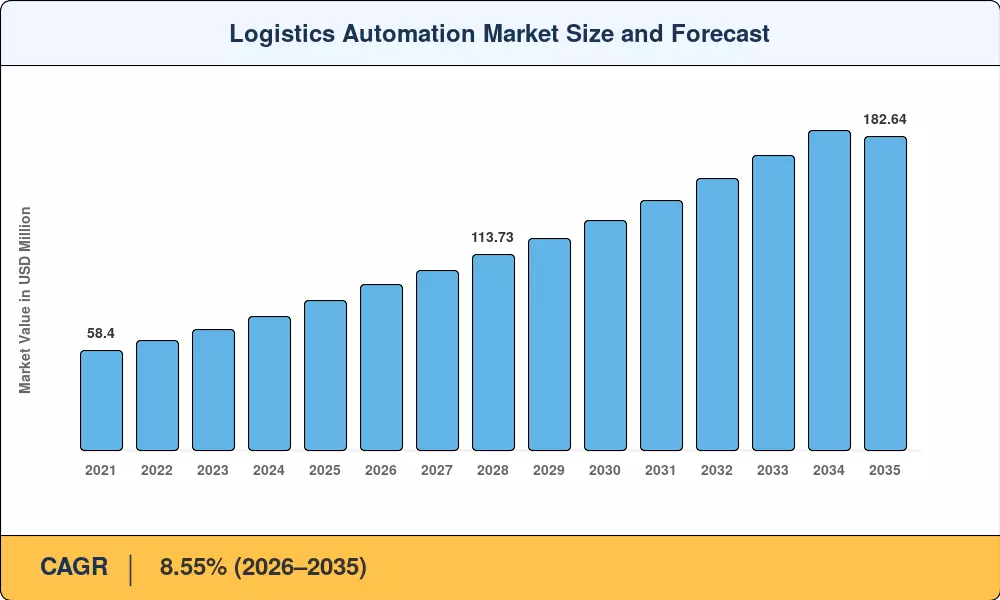
The global transition toward Industry 4.0 principles has further accelerated the integration of connected technologies across distribution centers, fulfillment hubs, and transportation networks, ushering in an era of intelligent, data-driven logistics operations.The Logistics Automation Market was valued at USD 86.95 billion in 2025 and is projected to reach USD 96.52 billion in 2026 before climbing to USD 182.64 billion by 2035, expanding at a CAGR of 8.55% during 2026–2035.
Leading Industry Participants
The logistics automation market is highly competitive and dominated by a blend of global technology conglomerates, specialized robotics manufacturers, and innovative software solution providers. These companies continue to invest heavily in R&D, strategic partnerships, and mergers and acquisitions to strengthen their market presence and expand their product portfolios. The key players shaping the global logistics automation landscape include:
• Honeywell Intelligrated (USA)
• Daifuku Co., Ltd. (Japan)
• Dematic Group (USA/Germany)
• Vanderlande Industries (Netherlands)
• Knapp AG (Austria)
• SSI Schaefer (Germany)
• Swisslog Holding AG (Switzerland)
• Murata Machinery, Ltd. (Japan)
• Mecalux, S.A. (Spain)
• Fetch Robotics (USA)
• 6 River Systems (USA)
• Geek+ (China)
• GreyOrange (India/USA)
• TGW Logistics Group (Austria)
• Elettric80 (Italy)
These organizations are at the forefront of developing end-to-end automated solutions that integrate hardware, software, and artificial intelligence to deliver measurable efficiency gains across the supply chain.
Download Sample Pages of Research Overview -
https://www.marketresearchfuture.com/sample_request/8019
Key Growth Factors
Several macro and micro-level factors are collectively fueling the robust growth trajectory of the logistics automation market. The unprecedented surge in e-commerce transactions accelerated significantly by the COVID-19 pandemic has compelled retailers, third-party logistics (3PL) providers, and manufacturers to overhaul their warehousing and fulfillment infrastructure. Consumer expectations for same-day and next-day deliveries have made manual operations inadequate, creating urgent demand for automated picking, packing, sorting, and dispatch systems.
Labor shortages in warehousing and logistics sectors across developed economies, particularly in the United States, Germany, Japan, and the United Kingdom, have pushed companies to replace repetitive manual tasks with robotics and autonomous systems. Additionally, advances in artificial intelligence, computer vision, machine learning, and the Internet of Things (IoT) have significantly reduced the cost and complexity of deploying automation solutions, making them accessible to mid-market and even smaller enterprises. Government initiatives supporting smart manufacturing, digital infrastructure investment, and supply chain resilience further bolster the adoption of logistics automation technologies on a global scale.
Emerging Growth Opportunities
The logistics automation market presents a wide array of emerging opportunities that are set to redefine operational excellence and competitive differentiation. The proliferation of autonomous mobile robots (AMRs) offers businesses scalable, flexible automation solutions that can be rapidly deployed and reconfigured without extensive infrastructure changes, creating immense growth potential in dynamic fulfillment environments. The integration of generative AI and predictive analytics into warehouse management systems is opening new frontiers for real-time inventory optimization, demand forecasting, and proactive maintenance of automated equipment.
Cold chain automation is gaining considerable momentum, driven by the booming pharmaceutical, biotechnology, and fresh grocery sectors, where precision temperature control and traceability are non-negotiable requirements. The rapid expansion of omnichannel retail is creating demand for sophisticated order management and returns automation systems. Emerging markets in Southeast Asia, Latin America, and the Middle East present significant greenfield opportunities, as these regions invest in modernizing their logistics infrastructure to support fast-growing consumer markets. Micro-fulfillment centers positioned closer to urban consumer bases represent another compelling growth avenue, enabling hyper-local delivery networks powered by automation.
Key Market Barriers & Challenges
Despite its strong growth prospects, the logistics automation market faces a set of significant barriers that could moderate its expansion pace. The high upfront capital investment required for deploying automated systems, including robotic hardware, conveyor infrastructure, software platforms, and system integration, remains a critical deterrent for small and medium-sized enterprises (SMEs) that operate on tighter margins. The complexity of integrating new automation technologies with legacy IT systems and existing warehouse layouts poses considerable technical and operational challenges, often resulting in extended implementation timelines and cost overruns.
Workforce resistance to automation-driven job displacement continues to create organizational friction, particularly in regions with strong labor unions and regulatory protections. Cybersecurity vulnerabilities in increasingly connected logistics networks represent a growing risk, as automated systems become prime targets for data breaches and operational disruptions. Furthermore, the rapid pace of technological evolution means that organizations risk investing in solutions that may become obsolete within a few years, raising concerns about the long-term return on investment and total cost of ownership.
Segment-wise Market Breakdown
The logistics automation market is broadly segmented based on component type, function, end-user industry, and deployment model. Understanding these segments provides a granular view of where investment is concentrated and where future growth will emerge. The key market segments include:
By Component:
• Hardware (Robots, Conveyors, Sortation Systems, AGVs, AMRs)
• Software (WMS, WCS, ERP Integration), Services (Installation, Maintenance, Consulting)
By Function:
• Warehouse & Storage Automation
• Transportation & Freight Automation
• Order Fulfillment & Picking Automation
• Last-Mile Delivery Automation
By Technology:
• Robotics Process Automation (RPA)
• Artificial Intelligence & Machine Learning
• Internet of Things (IoT)
• Barcode/RFID Scanning
• Vision Systems
By End-User Industry:
• Retail & E-commerce
• Food & Beverage
• Healthcare & Pharmaceuticals
• Automotive
• Electronics
• Third-Party Logistics (3PL)
By Deployment:
• On-premise
• Cloud-based
• Hybrid
By Enterprise Size:
• Large Enterprises
• Small & Medium Enterprises (SMEs)
Among these segments, warehouse and storage automation commands the largest market share, while last-mile delivery automation is expected to register the fastest growth rate through 2035, driven by the explosion in direct-to-consumer e-commerce shipments.
Browse In-depth Market Research Report - https://www.marketresearchfuture.com/reports/logistics-automation-market-8019
Geographical Market Insights
Geographically, North America holds the dominant position in the global logistics automation market, underpinned by its highly developed e-commerce ecosystem, strong technology adoption culture, significant capital investment in supply chain modernization, and the presence of major market players. The United States, in particular, leads North American demand, with companies like Amazon, Walmart, and Target deploying billions of dollars in automated fulfillment infrastructure.
Europe represents the second-largest market, with Germany, the United Kingdom, France, and the Netherlands emerging as key contributors, driven by strong manufacturing bases, advanced retail sectors, and supportive government initiatives under the EU's digital economy strategy.
The Asia-Pacific region is poised to be the fastest-growing market over the forecast period, fueled by the explosive growth of e-commerce in China, India, Japan, and Southeast Asia, increasing labor costs, and substantial government investments in smart logistics infrastructure. China, in particular, has emerged as a global leader in logistics robotics adoption, with domestic giants like Alibaba, JD.com, and Geek+ pioneering large-scale automated fulfillment networks.
Latin America and the Middle East & Africa represent emerging markets with immense untapped potential, as regional logistics operators increasingly prioritize modernization to meet rising consumer demand and improve operational efficiency.
➤ Frequently Asked Questions (FAQs)
1. What is the Logistics Automation Market?
The Logistics Automation Market refers to the use of advanced technologies such as robotics, artificial intelligence, warehouse automation systems, and software solutions to streamline and optimize logistics operations like transportation, warehousing, inventory management, and supply chain processes.
2. What are the key drivers of logistics automation growth?
Key drivers include rising e-commerce demand, labor shortages, increasing need for faster deliveries, cost reduction pressure, and advancements in AI, IoT, robotics, and cloud-based logistics platforms.
3. Which technologies are used in logistics automation?
Common technologies include warehouse management systems (WMS), autonomous mobile robots (AMRs), automated guided vehicles (AGVs), RFID systems, drones, and AI-powered supply chain analytics tools.
4. Which industries benefit most from logistics automation?
Industries such as e-commerce, retail, manufacturing, automotive, healthcare, and food & beverage benefit significantly from logistics automation due to high-volume supply chain operations.
5. What are the advantages of logistics automation?
It improves operational efficiency, reduces human errors, lowers costs, increases delivery speed, enhances inventory accuracy, and provides real-time visibility across the supply chain.
6. What are the challenges in adopting logistics automation?
High initial investment costs, integration with legacy systems, cybersecurity risks, and the need for a skilled workforce are some of the major challenges.
7. How does logistics automation impact supply chain management?
It enhances supply chain transparency, speeds up order fulfillment, improves demand forecasting, and enables real-time decision-making.
8. What is the future outlook of the logistics automation industry?
The industry is expected to grow rapidly due to increasing digital transformation, expansion of e-commerce, and adoption of smart warehouse technologies and AI-driven logistics solutions.
➤➤ Explore Emerging Opportunities with Market Research Future:
Immersive Analytics Market-
https://www.marketresearchfuture.com/reports/immersive-analytics-market-12229
Web3 In E-Commerce & Retail Market-
https://www.marketresearchfuture.com/reports/web3-in-e-commerce-retail-market-12249
Holographic Communication Market-
https://www.marketresearchfuture.com/reports/holographic-communication-market-12253
India Ott Market-
https://www.marketresearchfuture.com/reports/india-ott-market-12696
Us Augmented Reality Virtual Reality Market-
https://www.marketresearchfuture.com/reports/us-augmented-reality-virtual-reality-market-13796
Ai Text Generator Market-
https://www.marketresearchfuture.com/reports/ai-text-generator-market-18866
Wholesale Telecom Carrier Market-
https://www.marketresearchfuture.com/reports/wholesale-telecom-carrier-market-19241
Nigeria Telecom Market-
https://www.marketresearchfuture.com/reports/nigeria-telecom-market-20719
Sea Robotic Process Automation Market-
https://www.marketresearchfuture.com/reports/sea-robotic-process-automation-market-20730
United States Customer Relationship Management Crm Market -
https://www.marketresearchfuture.com/reports/united-states-customer-relationship-management-crm-market-21577
Sagar Kadam
Market Research Future
+ +1 628-258-0071
email us here
Legal Disclaimer:
EIN Presswire provides this news content "as is" without warranty of any kind. We do not accept any responsibility or liability for the accuracy, content, images, videos, licenses, completeness, legality, or reliability of the information contained in this article. If you have any complaints or copyright issues related to this article, kindly contact the author above.
